
UAE E-Invoicing – March 2026 Regulatory Update
UAE E-Invoicing – March 2026 Regulatory Update
The UAE Ministry of Finance has now issued a complete ecosystem blueprint for E-Invoicing, covering regulatory requirements, technical structure, and implementation mechanisms. The three key documents Guidelines, Mandatory Fields, and ASP Selection must be read together to understand the full impact on businesses.
A Paradigm Shift: From Documents to Data
The most fundamental change is that invoices are no longer “documents” (PDFs), but structured data (XML) transmitted in real time through a regulated network.
As outlined in the Guidelines, the UAE adopts a Peppol-based 5-corner model, where invoices flow through Accredited Service Providers (ASPs) and are simultaneously reported to the Federal Tax Authority (FTA).
This means:
- Businesses will not send invoices directly to customers anymore
- Instead, invoices are validated, standardized, and transmitted via ASPs
- Tax data is shared with the FTA almost in real time
Scope: Wider Than VAT
A critical clarification from the Guidelines is that E-Invoicing applies to all businesses, regardless of VAT registration.
This is a major shift from traditional VAT compliance.
- Even non-VAT registered entities must comply if conducting business
- Applies to B2B and B2G transactions
- Does not apply to B2C (consumer transactions)
Example:
A small consultancy firm (not VAT registered) providing services to another business still required to issue electronic invoices
Structured Data: The Core of Compliance
The Mandatory Fields document introduces a highly granular invoice data structure, significantly beyond current VAT invoice requirements.
Invoices must now include:
- Detailed invoice classification codes
- Transaction flags (e.g., export, free zone, margin scheme)
- Seller & buyer electronic identifiers
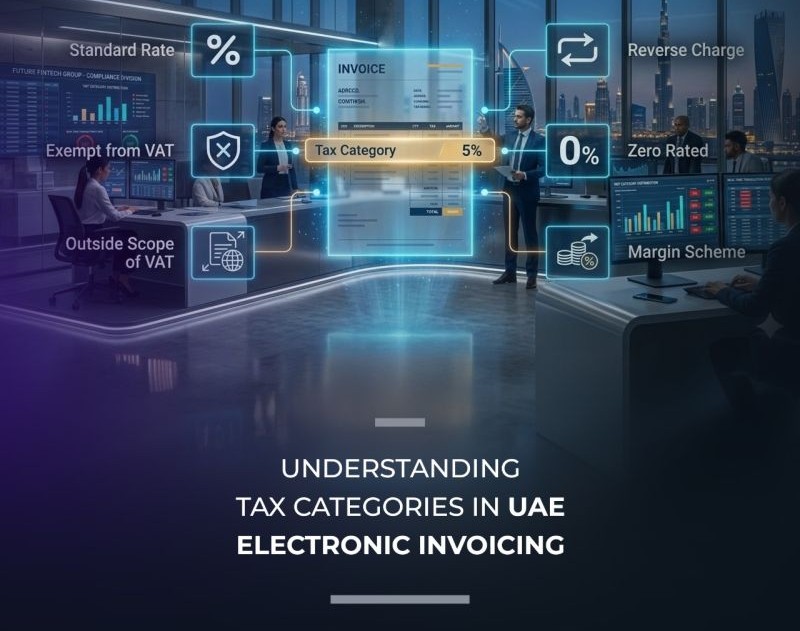
- Tax category codes and rates
- Line-level details (quantity, unit, price)
TIN Becomes the Backbone of the System
The system revolves around a new identifier:
- TIN = first 10 digits of TRN
This TIN is used as:
- Seller’s electronic address
- Buyer’s identifier
- Peppol participant ID
Example:
TRN: 100123456700003
TIN used in e-invoicing: 1001234567
Important nuance:
Even entities in a VAT group use their own TIN, not the group TRN.
Role of ASP: The Mandatory Intermediary
Businesses cannot directly connect to the FTA system.
Instead, they must appoint an Accredited Service Provider (ASP).
The ASP acts as:
- Validator
- Translator (to XML format)
- Transmission channel
- Reporting agent
Selecting the Right ASP: A Strategic Decision
The ASP selection document highlights that choosing an ASP is not just IT procurement it is a compliance decision.
Key evaluation factors include:
- Experience & Market Presence
- Peppol experience
- UAE regulatory understanding
- Integration Capability
- ERP compatibility (SAP, Oracle, etc.)
- API availability
- Compliance & Security
- Data protection standards
- UAE data accessibility requirements
- Pricing & Commercial Model
- Subscription vs per invoice
- Minimum 100 free invoices/year recommended
- Scalability
- Ability to handle future regulatory changes
Transitional Relief & Practical Challenges
The Guidelines recognize implementation challenges and provide relief:
- Intra-VAT group transactions get a 24-month grace period (from Jan 2027)
This is significant because:
- Intercompany transactions are high volume
- Systems may need major alignment
Data Retention & Audit Implications
The system also strengthens audit readiness:
- Minimum 5-year retention requirement
- 7 years for real estate records
Key clarification:
- Data can be stored outside UAE
- But must be accessible and reproducible for FTA
Business Impact: Beyond Compliance
While the regulation is compliance-driven, it introduces operational benefits:
- Faster invoice processing
- Reduced disputes (standardized data)
- Automated VAT reporting (future possibility)
- Improved audit readiness
However, the transition will require:
- ERP upgrades
- Process redesign
- Vendor/customer alignment
Key Risks Businesses Must Address Now
- Data gaps – missing mandatory fields
- ERP limitations – inability to generate structured data
- Wrong ASP selection – leading to integration failure
- TIN mapping errors – causing rejection in network
- Process readiness – especially for high-volume transactions
Final Thoughts
UAE E-Invoicing is not just a tax reform it represents a fundamental shift toward real-time digital tax administration.
Businesses that act early by:
- Aligning systems
- Selecting the right ASP
- Structuring their data
…will move beyond compliance and gain operational efficiency, transparency, and future-ready tax processes.
Contact us today at 055 689 0505 or [email protected]